
The Disruptive Economics of Local AI vs. Token-Based APIs
Deep Research Analysis
Executive Summary
The enterprise artificial intelligence market is currently dominated by frontier models served via token-based cloud APIs. However, an analysis of the economic, regulatory, and technological trajectories reveals that these incumbents are highly vulnerable to Clayton Christensen’s model of Disruptive Innovation. By evaluating the Total Cost of Ownership (TCO) for a standard clinical workload (10 clinicians running 5 daily agents), we find that local, on-device AI deployments (Small Language Models or SLMs) are not only fundamentally cheaper at scale, but they also bypass the structural limitations of cloud APIs—such as data privacy, latency, and unpredictable pricing models.
This report demonstrates that we have passed the threshold of performance that enterprise customers-particularly in healthcare-can actually utilize from frontier models. Consequently, local AI is moving upmarket, shifting the basis of competition from raw capability to convenience, privacy, and fixed-cost economics.
1. The Performance Overshoot
Clayton Christensen’s theory of disruptive innovation posits that established companies continually improve their products to capture the highest-paying tier of the market . In doing so, they inevitably "overshoot" the performance needs of mainstream users.Today, frontier models (e.g., Anthropic Claude 4 Opus, OpenAI GPT-4.1) are overserving the market. The average daily tasks in a clinical setting—such as clinical scribing, SOAP note generation, and basic workflow automation—do not require a trillion-parameter model . Research from NVIDIA and Red Hat confirms that Small Language Models (SLMs) fine-tuned on high-quality data can achieve >98% validity in structured agentic tasks, matching or outperforming frontier models in specific tool-calling domains .Because frontier models exceed what clinicians can actually use, the basis of competition shifts away from general reasoning capability toward:
1.Data Sovereignty: Keeping sensitive patient data on-premise.
2.Cost Predictability: Moving from variable OPEX (tokens) to fixed CAPEX (hardware).
3.Latency and Reliability: Ensuring sub-second, deterministic execution without network dependency.
(See Figure 1 for the Christensen Overshoot trajectory).
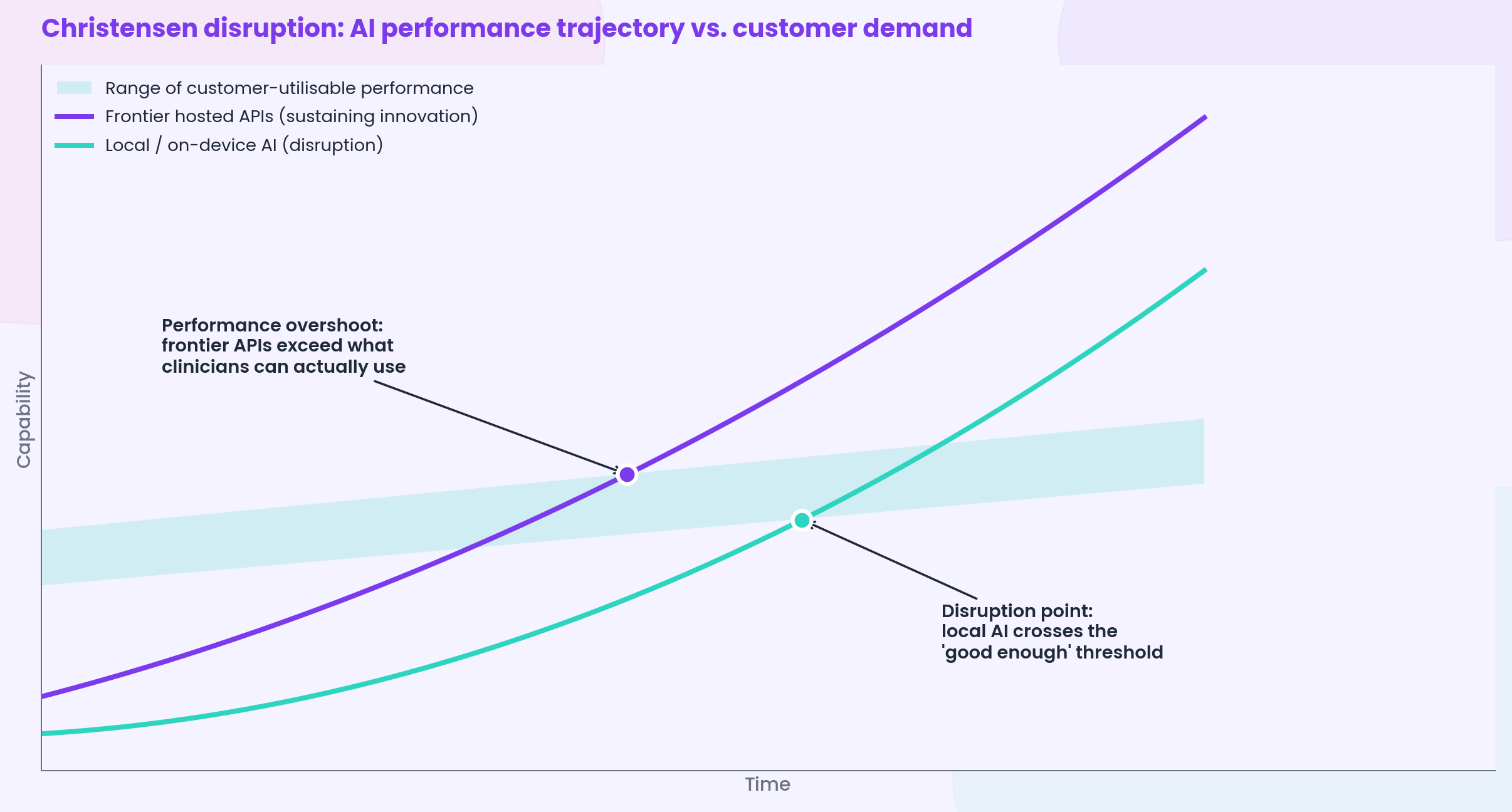
Figure 1: Christensen disruption trajectory showing local AI crossing the "good enough" threshold for clinical utility.
2. The Illusion of Cheap APIs and the Repricing Reality
Token-based API systems initially appear cost-effective due to strategic subsidization by frontier labs . However, the "lock-in" is real. As organizations move from simple chat interfaces to agentic workflows, where autonomous agents perform multiple planning, retrieval, and critique steps per task, token consumption explodes. Furthermore, as frontier labs face the physical price floors of data center operations and electricity, they are forced to adjust their pricing models.
- Anthropic has maintained premium positioning, with Claude 4 Sonnet costing $15.00 per million output tokens.
- Manus AI recently shifted from transparent token pricing to opaque "credits," effectively raising the cost-per-task by 5–10× relative to their beta period . A heavy agentic task can now consume up to 150 credits, pushing power users into expensive overage tiers.
3. Total Cost of Ownership (TCO) Comparison
To quantify this, we modeled a 10-clinician practice where each clinician uses 5 active AI agents daily (e.g., scribe, summarizer, scheduler). We assume 230 workdays per year and a heavy agentic workload requiring Retrieval-Augmented Generation (RAG) over local EHR notes.
Table 1: 3-Year Total Cost of Ownership (TCO) Comparison
Scenario: 10 Clinicians, 5 Agents/Day, Heavy RAG Context (207,000 total LLM calls/year).
Deployment Model | Year 1 Cost (EUR) | Year 3 Cumulative TCO (EUR)* | Cost per Clinical Encounter (Yr 1) |
Local AI (Isaree on MacBook M5 Max) | €3,105 | €9,315 | €0.07 |
OpenAI GPT-4.1 mini | €7,257 | €21,771 | €0.16 |
OpenAI GPT-4.1 | €15,884 | €50,830 | €0.35 |
Anthropic Claude 4 Sonnet | €22,257 | €75,673 | €0.48 |
Manus AI Extended | €47,610 | €183,298 | €1.04 |
*Year 3 TCO includes realistic vendor price escalation (10-30% for frontier APIs, 60% for Manus credits). USD rate cards converted at 2026 reference rate of 1 USD = 0.92 EUR.Local AI Cost Breakdown:The €9,315 three-year TCO for Local AI is calculated based on a deployment where clinicians utilize their existing hardware (MacBook Pro M5 Max), drawing ~35W during active inference with community-driven support:
• Hardware: €0 (Clinicians' existing work laptops; sunk cost)
• Electricity: €105/year (10 users × 35W × 4h/day × 250 days × €0.30/kWh)
• Ops/Maintenance Labor: €0 (Community-driven self-hosted support)
• Isaree Platform License: €9,000 (One-time €900/user 3-year license for 10 users, amortised at €3,000/year)
Total: (3 × €3,105) = €9,315
Note on Estimates: The token consumption, escalation rates, and hardware utilization figures are estimates based on standard clinical workflows and industry pricing trends as of Q2 2026. Actual TCO may vary depending on specific institutional constraints.Key Takeaways from the TCO Model:1.The Agentic Multiplier: Because agents require massive context windows (system prompts + memory + RAG), the token volume makes premium APIs (Anthropic, Manus) prohibitively expensive at scale.2.Fixed vs. Variable: Local AI requires an upfront hardware investment and a platform fee, but the marginal cost of an additional query is just electricity.
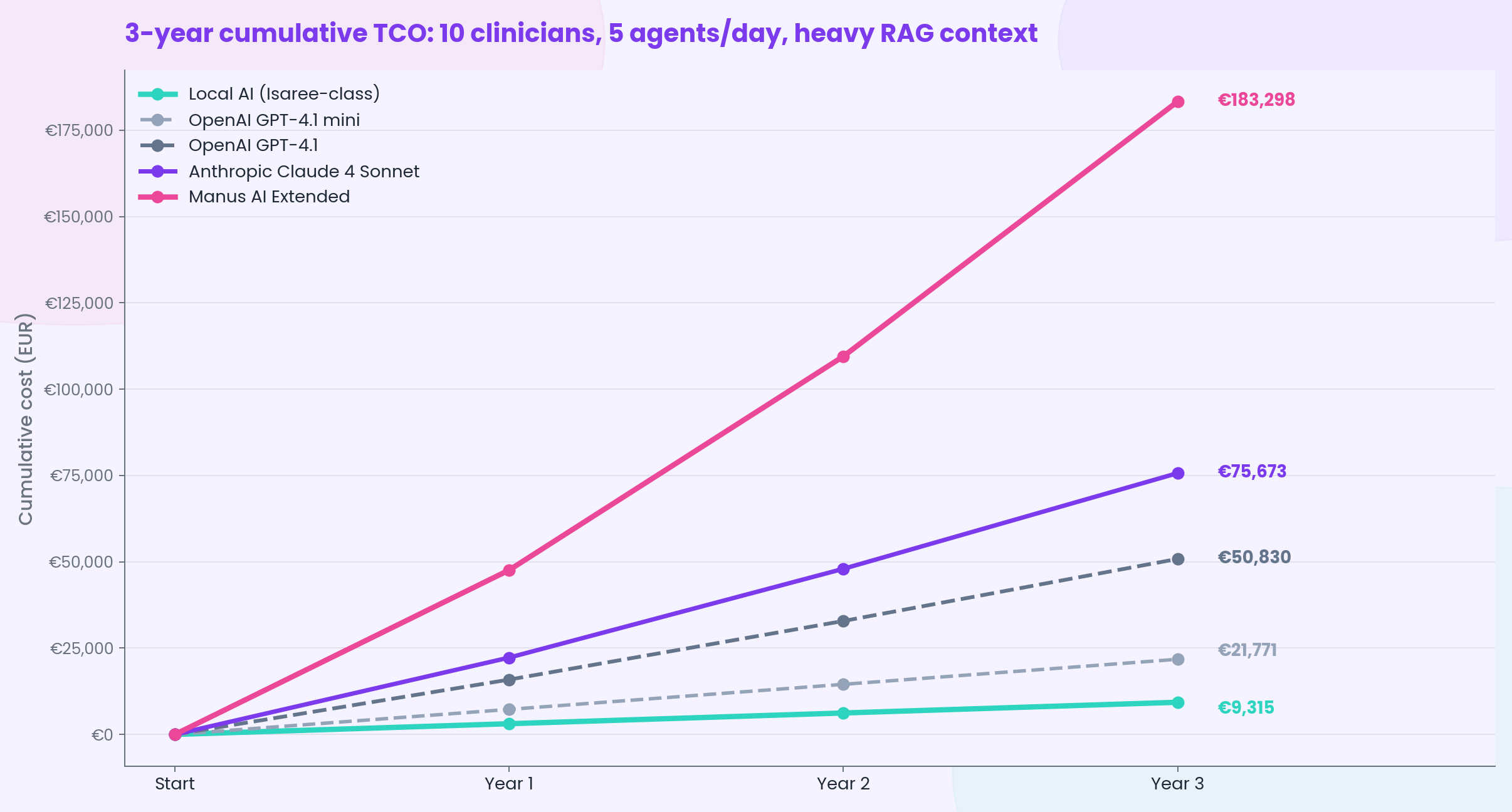
Figure 2: Cumulative TCO over 3 years. Local AI flattens out, while API costs compound linearly or exponentially with price hikes.
4. Clinical Utility and Regulatory Compliance
In healthcare, the cost of the model is secondary to the cost of compliance. The EU AI Act classifies AI-enabled medical devices as high-risk by default . For frontier API-based clinical AI, certification is structurally difficult because the model is a moving target (frequent silent updates) and data crosses jurisdictions.Local, on-device SLMs—such as Apple's Foundation Models running on clinician hardware—are frozen, auditable, and deployed on-premise . This makes certification materially simpler and eliminates the need for complex Business Associate Agreements (BAAs) regarding data retention.
Table 2: Clinical Utility & Compliance Matrix
Feature / Requirement | Local AI (On-Device / Edge) | Token-Based Hosted APIs (Cloud) |
Patient Data Privacy (GDPR/HIPAA) | Native (Zero data leaves the device/premise) | Requires complex BAAs & zero-retention add-ons |
EU AI Act Certification | High Feasibility (Frozen, auditable SLMs) | Low Feasibility (Moving target, black-box updates) |
Offline Availability | 100% Available (Critical for emergency/battlefield) | 0% Available (Fails without internet) |
Latency | Sub-second (Local inference) | Variable (Subject to network and API rate limits) |
Agentic Scalability | Infinite (Marginal cost of execution is near €0) | Hard-capped (Token costs scale linearly with use) |
5. Christensen Disruption Analysis Summary
To summarize the strategic landscape using Christensen's framework:
Table 3: Christensen Disruption Analysis
Dimension | Token-Based Hosted APIs (Incumbents) | Local AI / SLMs (Disruptors) |
Target Market | General enterprise, high-end reasoning tasks | Edge use-cases, privacy-critical sectors (Healthcare) |
Performance vs. Utilization | Overshooting: Trillion parameters, exceeding daily clinical needs | Good Enough: 3B-8B parameters, excelling at specific tool-calling |
Cost Structure | High gross margins (80-95%), vulnerable to token bloat | Low marginal cost, leveraging commoditized hardware (Apple Silicon) |
Business Model | Rent-seeking via tokens and opaque "credits" (e.g., Manus AI) | Freemium/Platform fee (e.g., Isaree), enabling a clinician-creator marketplace |
Conclusion
The era of relying exclusively on centralized, monolithic cloud APIs for enterprise automation is ending. As organizations deploy multiple agents per employee, the token-based business model becomes a massive financial liability. Local AI, powered by open-source SLMs and robust edge hardware, has crossed the threshold of "good enough" performance. By solving the structural issues of data sovereignty, offline availability, and exponential cost scaling, Local AI is poised to thoroughly disrupt the incumbent API providers, particularly in highly regulated industries like healthcare.
References
[1] Christensen Institute. "Disruptive Innovation." Christensen Institute Theory.[2] Red Hat. "Small models, big impact: The future of scaling enterprise AI agents." Red Hat Blog, Feb 2026.
[3] Alderson, M. "Are OpenAI and Anthropic really losing money on inference?" Aug 2025.
[4] Dataku.ai. "The AI API price tracker: 5 years of data in one interactive chart." Apr 2026.
[5] Anthropic. Claude Platform Pricing.
[6] Manus AI. Pricing & Credits. May 2026.
[7] Emergo by UL. "The European AI Act: Requirements for High-Risk AI Systems." Jul 2024.
[8] AppleInsider. "Privacy & data security will remain tantamount for Apple's AI." May 2026.