Don't Start with AI. Start with a Workflow.
It's the weekend, so why not give building with Isaree a try?
Here you'll find the guide for your first agent and the six phases that follow.
If you do not have access yet - register on the wiatinglist.
Part 1 of 2. Part 2 — Build a Brain, Not a Dependency →
German Version
Dutch Version
We launched our Community Edition for iOS and macOS in alpha version. It runs 100% on your device. It integrates with your local files, your mail, your practice software, and the web. And when your agents need to reach external services, clinical databases, research APIs, evidence networks, if needed Isaree de-identifies patient data before it leaves your device, so the value comes back without the data going out. In the weeks since, we've been talking to clinicians and healthcare leaders from across the globe.
They all ask the same question.
Not "what can it do?" They've read the posts. They know the thesis. The question is more practical, more human, and more honest:
"How do I start?"
This post is the answer. Not a feature list. Not a pitch. A guide for the person who has the tool in their hands and wants to know what to do first, what to expect, and what happens when they keep going.
The model is a commodity. The harness is the product.
Satya Nadella put it plainly in a recent essay: the real opportunity is not in picking the best model, but in building a learning loop on top of models. The model, he wrote, is increasingly something you can swap out. The durable value lives in the system you build around it.
LangChain put a number on the same idea. They took one coding model, changed nothing about the model itself — same weights, zero retraining — and improved only the scaffolding around it. On the Terminal Bench 2.0 benchmark, that model jumped from 52.8% to 66.5%. From somewhere around 30th place into the top five. Same brain. Different body. Completely different agent.
That scaffolding has a name: the harness. And it's the thing that separates an AI agent that works from one that only seems to.
The equation is simple enough to fit in a tweet:
Agent = Model + Harness.
The model is the AI — the thing that reasons, that generates text, that makes decisions. The harness is everything else: the tools the agent can call, the permissions that govern what it's allowed to touch, the memory that persists between sessions, the verification that catches bad output before it ships, the sandbox that contains the damage when something goes wrong.
If the model is a brilliant mind sitting in a sensory deprivation tank, the harness is the body, the senses, the notebook, and the to-do list. On its own, a language model does exactly one thing: it takes text in and produces text out, once, with no memory of the last time you called it and no way to act in the world. It cannot open a file. It cannot run a command. It cannot remember what it figured out yesterday. Every one of those capabilities is a harness feature.
-b941e3.png)
Anyone can rent the same model. Nobody can rent the loop of workflows, checks, and accumulated knowledge you build around it. The model is the commodity. The harness is the part that compounds. And the harness is the part you own.
This is where Isaree's philosophy diverges from almost every other AI company. The dominant model in the industry is designed so that each interaction makes the platform more powerful — it learns your patterns, accumulates your data, increases your switching costs, tightens its grip. You become more dependent. The company becomes more indispensable. The relationship runs one direction.
We built Isaree to invert that. Each interaction makes you more sovereign. Every correction you make becomes a rule you own. Every workflow you build becomes a skill you control. Every session compounds into a brain that lives on your device, answers to your permissions, and leaves when you say so. You don't gain capability by surrendering data. You gain capability by owning the infrastructure that produces it. The harness grows. Your sovereignty grows with it. That's not a feature. It's the founding principle of the company.
Start with the right person
Most onboarding guides assume the reader is a developer. Ours doesn't. We built Isaree for a specific person — and if you're reading this, there's a good chance you're already them.
We call this person the Clinician-Innovator. They're a frontline healthcare professional — a physician, a nurse, a specialist, a therapist — with direct patient care responsibilities. But that's their job title, not their identity. Their identity is simpler: they are a problem-solver first, a clinician second.
You know this person. They're the one who builds elaborate spreadsheet templates to track patient data because the EMR won't do what they need. They write detailed bug reports for software most of their colleagues have given up on. They're the one who turns to a colleague in the break room and says, "What if we could just..."
They are intellectually curious. They are comfortable with technology — not necessarily coders, but power users of everything they touch. They are not intimidated by new tools. They are intimidated by the idea of spending another decade working inside systems that were designed for someone else's workflow.
And they share one driving frustration: lack of autonomy. They feel constrained by one-size-fits-all EMRs and IT systems that create administrative burdens and hinder patient care. They believe — correctly — that the people closest to the problem are the best equipped to design the solution.
They are not looking for another piece of software to learn. They are looking for a set of building blocks to create the tools they wish existed.
If that's you, you're in the right place. And you're not alone — you're the beachhead.
The adoption journey
Mitchell Hashimoto — the creator of Terraform — wrote a post in February 2026 about his own AI adoption journey. He described three phases that anyone goes through when adopting a meaningful tool: a period of inefficiency, a period of adequacy, and finally a period of workflow-altering discovery. The friction of phases one and two is the price of admission. Most people quit in phase one.
We've watched the same journey happen with clinicians using Isaree.
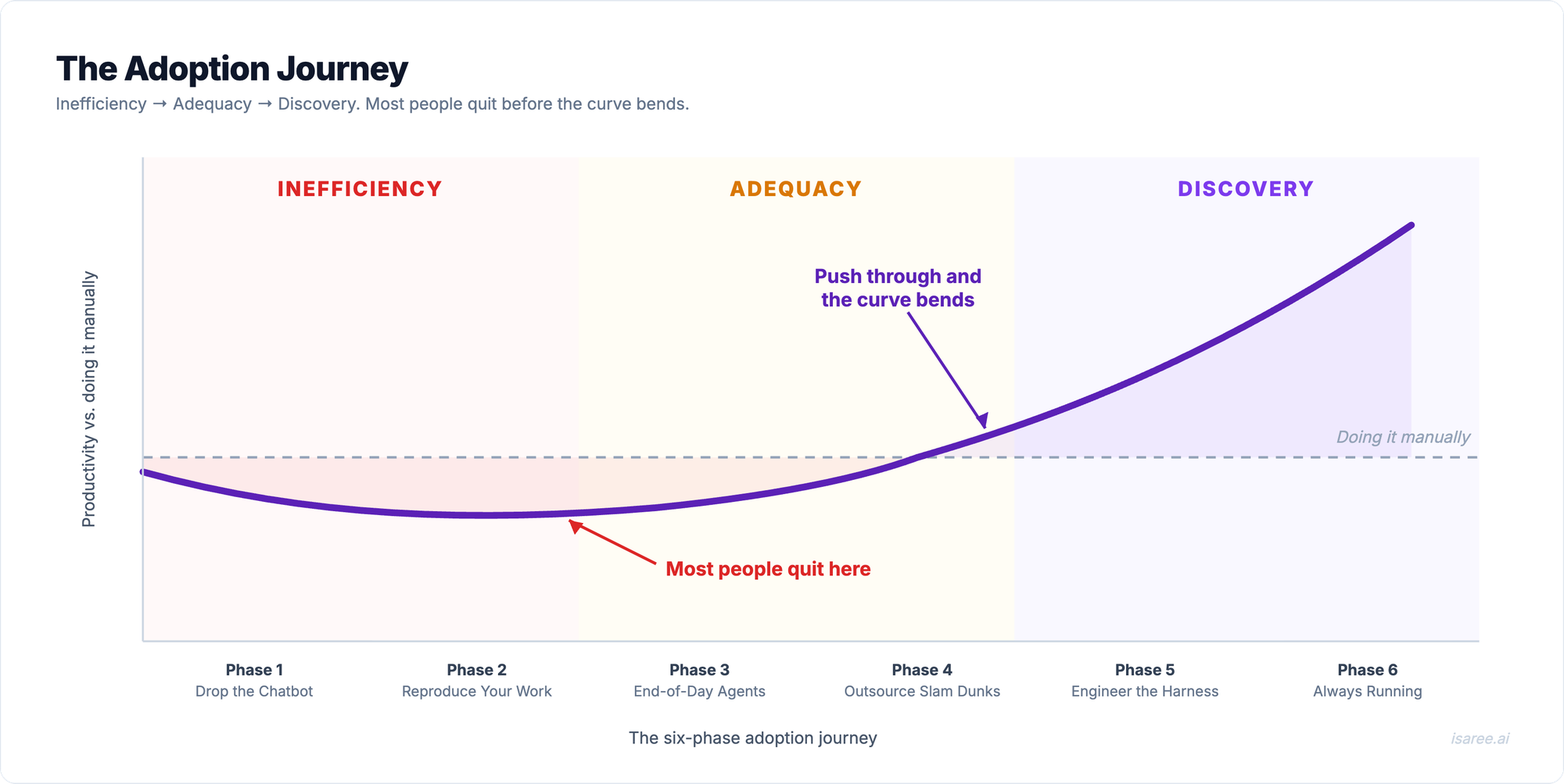
Here's what it looks like, adapted from what we've learned.
Phase 1: Drop the chatbot
Your first experience with AI was probably a chat interface. You typed a question, it answered. Useful for drafting an email, summarizing an article, looking up a drug interaction. But the moment you tried to get it to do real work — something that involves your files, your patient data, your workflow — you hit a wall. You copied and pasted. You corrected it. You corrected it again. It was slower than doing it yourself.
That's because a chatbot is the simplest possible harness: a while loop that takes text in and sends text out. No tools. No memory. No access to your world. To find real value, you need an agent — an LLM that can read files, execute programs, and make requests. A chatbot answers. An agent acts.
Isaree is not a chatbot. It's a harness — paired with a community-driven agent hub where you can download agents built on our agent builder platform, share your own, and learn from what others have already solved. The first shift is understanding the difference: a chatbot answers. An agent acts. A harness compounds.
Phase 2: Reproduce your own work
Hashimoto's breakthrough came when he forced himself to reproduce his manual work with agents. He'd do the work by hand, then fight an agent to produce the same result — without it seeing his solution. It was excruciating. But expertise formed. He discovered, from first principles, what worked and what didn't.
The clinician's version of this is simpler. Pick one workflow you do every day. A referral letter. A triage of overnight messages. A literature check before a morning round. Do it manually, as you always have. Then do it with Isaree. Compare. Adjust. Correct the agent when it's wrong — and every correction teaches it something permanent.
You will be slower at first. This is normal. This is the inefficiency phase. You are paying a setup cost that will return itself many times over, but only if you push through.
Part of that cost is a choice we made deliberately. We could ship Isaree as a sealed box — one model, one configuration, one way of working, zero decisions. It would be easier on day one. It would also be a cage. Instead, we give you maximum flexibility: you choose your harness model, your agent models, your orchestrator, your integrations. You decide whether to run everything locally or route heavier tasks through a stateless external layer. You decide which agents from the hub to adopt and which to build from scratch.
That flexibility has a price. More choices mean more learning, more initial friction, more time spent understanding the moving parts before they move for you. We accept that trade — because a harness you configure is a harness you own, and a harness you own is the only kind that compounds in your direction. Convenience you rent. Capability you build. We chose the latter, and we think you will too, once you're through phase one.
-7f1eea.png)
Three principles from this phase, learned the hard way by people who've done it:
- Break sessions into separate, clear tasks. Don't try to draw the owl in one mega-session. One workflow per session. One correction at a time.
- Split vague requests into planning and execution. First, ask the agent to plan. Then ask it to execute. Two sessions, not one.
- Give the agent a way to verify its work. If you give an agent a way to check itself, it more often than not fixes its own mistakes and prevents regressions. In a clinical context: point it at the guideline, the protocol, the reference range. Let it check against the source of truth.
Phase 3: End-of-day agents
Once you're comfortable, the next shift is temporal. Instead of trying to do more in the time you have, do more in the time you don't have.
Hashimoto blocked out the last 30 minutes of every day to kick off agents. Deep research surveys. Parallel agents exploring vague ideas. Issue triage. He'd arrive the next morning to a warm start — reports waiting, paths illuminated, the cognitive heavy lifting already done.
The clinician's version: before you leave for the day, set an agent to survey the latest literature on a condition you're researching. Set another to triage the inbox you didn't finish. Set a third to draft the summaries you'll need for tomorrow's rounds. You come back to a desk that's already been worked on — not by a stranger, but by an agent that knows your brain, your preferences, your corrections.
But let's be honest about what this looks like in the beginning. Your first agent — whether you build it from scratch or download it from the hub — will be experimental. It won't know your context. It won't know your patients, your protocols, your preferences, the way your department actually works versus how the manual says it works. It will get things wrong. It will draft a summary that misses the detail that matters. It will surface a paper that isn't quite relevant. That's not a failure. That's the starting position.
This is why the early days are best spent on personal research and non-critical workflows — literature surveys, inbox triage, drafting first passes that you'll revise yourself. You're not deploying a clinical tool on day one. You're training a colleague. Each correction you make, each "not quite, try it this way," each rule you add to your brain is an investment in contextual understanding. The agent that starts as an experiment becomes a tool. The tool becomes a collaborator. The collaborator becomes infrastructure. But only if you give it the time to learn — and only if you're willing to start where the stakes are low and the learning is high.
Phase 4: Outsource the slam dunks
By this point, you know what your agent does well and what it doesn't. The tasks it nails every time — the slam dunks — you delegate entirely. You start the agent, turn off notifications, and go work on something else. During natural breaks, you check on it. You stay in control of when you interrupt the agent, not the other way around.
This is where the efficiency curve bends. You're not babysitting anymore. You're directing. The agent handles the repetitive, the mechanical, the well-understood. You handle the judgment, the nuance, the work that requires your expertise. You trade off skill formation on the tasks you delegate, but you continue forming skills on the work you keep — which is the work that matters.
Phase 5: Engineer the harness
This is where it gets permanent. Hashimoto's rule: anytime an agent makes a mistake, engineer a solution so it never makes that mistake again. Not a prompt tweak. A rule. A permanent change to the environment.
In Isaree, this means adding to your brain. Every correction becomes a rule. Every discovery becomes a skill. Every preference becomes a default. The agent that made the mistake yesterday can't make it tomorrow, because the harness now prevents it. This is not a one-time setup. It's a living discipline. Your harness grows one rule at a time, each rule born from a failure, each failure permanently retired.
We should be honest here: we're on the same journey. Isaree is currently in alpha, moving to beta soon, and we're learning too. Building the first fully local AI agent for healthcare is hard. We're refining the harness, the builder, the integrations — and we're doing it alongside the clinicians who use it, not behind a closed door. So bear with us. When something breaks, tell us. When something could be better, tell us. The platform grows with your corrections, the same way your brain grows with the agent's. We're building this together.
Phase 6: Always have an agent running
The final shift is a mindset. If an agent isn't running, ask yourself: is there something an agent could be doing for me right now? Not running agents for the sake of it — only when there's a task that would genuinely help. But the default flips. The agent becomes a constant presence, a colleague that never sleeps, never forgets, and gets smarter with every interaction.
Hashimoto estimated he was effective at having a background agent running about 10 to 20% of a working day. He was actively working to improve that. So are we. So are the clinicians in our cohort.
Start with one
You don't need to understand harness engineering to begin. You don't need to know what MCP stands for. You don't need to have read the research on compounding curves or the post-mortems on the July incidents.
You need one workflow that annoys you. One task you repeat every day that could be fifteen minutes faster. One "what if we could just..." that you've been carrying around.
Start there.
Drop the chatbot. Pick one workflow. Reproduce it with an agent. Correct it when it's wrong. Add each correction to your brain. Do it again tomorrow. And the day after.
The harness is on your device. The integrations are ready — your files, your mail, your browser, your practice software. The brain is yours to build. And every interaction from here makes the next one better.
When someone says "I built an agent," what they mean is: they built a harness and pointed it at a model. The model is available to everyone. The harness is where the differentiation lives. And the harness that matters most is the one that lives on your device, knows your workflow, and compounds with every session.
The question was never "what can it do?" The question was always "how do I start?"
Start with one workflow. Build your first agent. Then your brain.
The curve does the rest.
In Part 2, I explain how the brain works, why proximity AI matters, and what the compounding curve actually looks like over time.
Bart de Witte is the founder of Isaree, pioneering on-device, clinician-empowered AI for healthcare. He writes about digital health, AI architecture, and the long tail at blog.isaree.ai.